The Section 232 Squeeze: How National Security Tariffs Are Reshaping U.S. Clean Energy Economics
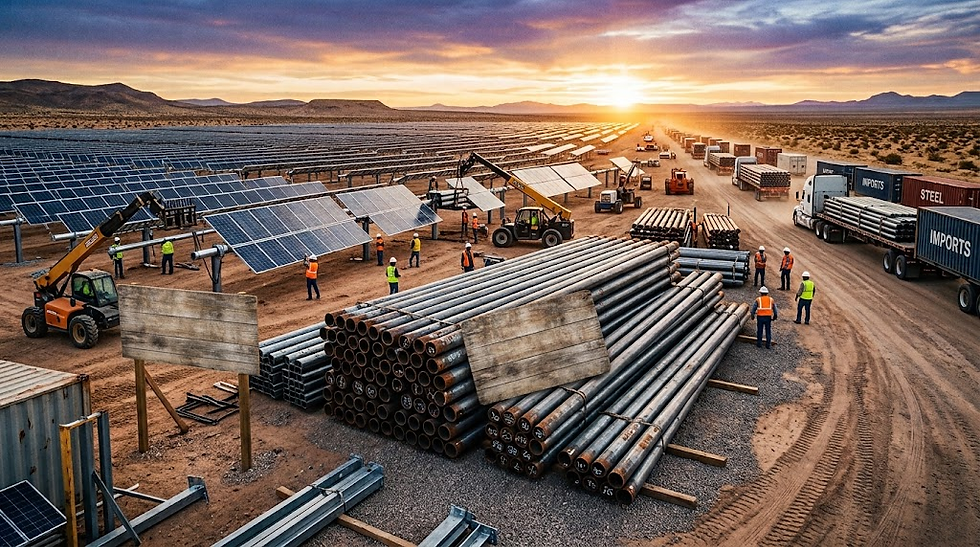
As the U.S. energy transition accelerates, a Cold War-era trade tool is re-emerging as a primary driver of project costs. Section 232 tariffs on steel and aluminum are no longer just "background noise" for manufacturers; they are now a central variable in CapEx modeling, PPA negotiations, and supply chain strategy for clean energy developers nationwide.
What Is Section 232? (The Brief Context)
Unlike typical trade disputes that focus on price dumping, Section 232 of the Trade Expansion Act of 1962 is rooted in national security. It grants the U.S. President broad authority to impose adjust imports—via tariffs or quotas—if a Department of Commerce investigation finds that specific products are being imported in such quantities or under such circumstances as to "threaten to impair the national security."
Key characteristics include:
Executive Discretion: Once a threat is identified, the President has wide latitude to determine the remedy without requiring a vote from Congress.
National Security Focus: The rationale is often the preservation of "critical infrastructure" and the domestic industrial base.
Broad Scope: While primarily targeting raw steel and aluminum, the scope has expanded to include "derivative articles" (such as steel nails or aluminum cables) and has direct implications for the solar supply chain, specifically metal intensive components like racking and trackers.
The Difference from AD/CVD: While Antidumping and Countervailing Duties (AD/CVD) target "unfair" pricing from specific companies or countries, Section 232 can be applied globally or to specific regions based on geopolitical alliances.
Comparing the Trade Levers: Section 232 vs. Section 301 vs. AD/CVD
Navigating the U.S. trade landscape requires distinguishing between three primary mechanisms that often "stack" on top of one another.
Dimension | Section 232 | Section 301 | AD/CVD |
Statutory Authority | Trade Expansion Act of 1962 | Trade Act of 1974 | Tariff Act of 1930 |
Core Rationale | National Security | Unfair Trade Practices (IP, Tech) | Pricing below cost / Subsidies |
Key Agencies | Dept. of Commerce (BIS) | U.S. Trade Representative (USTR) | Commerce (ITA) & ITC |
Discretion | Very High (Presidential) | High (Presidential) | Low (Fact-based/Quasi-judicial) |
Clean Energy Scope | Steel, Aluminum, Transformers | Solar Cells, BESS, EVs | Cells, Modules, Towers, Castings |
Tariff Stacking | Often stacks with 301/AD | Common for China-origin goods | Applied to specific manufacturers |
Origin Standard | Melt and Pour / Smelt and Cast | Substantial Transformation | Country of Origin (Processing) |
Finance Impact | High CapEx Volatility | Specific to China-supply risk | Retrospective Duty Risk |
The 'Triple-Stack' Risk: Developer Analysis
The primary risk for developers today is the Triple-Stack. For example, a solar tracker manufacturer using steel from a specific Asian market might face Section 232 duties (National Security), Section 301 duties (if processed in China), and AD/CVD duties (if the steel is found to be subsidized). This can lead to effective tariff rates exceeding 100% of the component value, rendering original project pro formas obsolete overnight.
Sector-by-Sector Market Impacts
The clean energy industry is particularly vulnerable to metal-intensive tariffs due to the sheer volume of structural material required for utility-scale deployment.
Utility-Scale Solar
Solar racking and trackers are the primary targets. As developers shift toward larger format modules, the structural requirements for steel torque tubes and aluminum frames increase. Section 232 costs are now a line-item negotiation in Master Supply Agreements (MSAs), with manufacturers increasingly passing through 100% of tariff volatility to the developer.
Wind Energy
Wind turbines are essentially giant steel towers. Towers, foundations (monopiles), and nacelle castings are heavily impacted by Section 232. Offshore wind, in particular, faces a specialized challenge: the massive amount of steel required for subsea foundations often must be sourced internationally due to domestic capacity constraints, forcing developers to choose between high tariffs or limited local supply.
BESS and Balance of Plant (BoP)
While the focus for Battery Energy Storage Systems (BESS) is often on lithium-ion chemistry (Section 301), the enclosures and thermal management systems are subject to Section 232. Furthermore, the Balance of Plant—including transformers and power electronics—is increasingly scrutinized under "derivative" categories, as the U.S. seeks to secure the electrical grid's core hardware.
Technical Deep Dive: De-Risking Origin
The Department of Commerce has recently tightened the definitions of "origin" to prevent tariff circumvention. Understanding these terms is critical for procurement teams.
'Melt and Pour' vs. 'Smelt and Cast'
Steel (Melt and Pour): To qualify as non-subject to certain 232 duties (particularly regarding the Mexico/Canada arrangements), steel must be "melted and poured" in a qualified country. Merely rolling or finishing steel in a friendly nation is no longer sufficient if the raw slab came from a sanctioned source.
Aluminum (Smelt and Cast): Similarly, for aluminum, the "smelt and cast" rule requires the primary aluminum to be produced in a specific region. Clean energy developers must now audit their Tier 3 and Tier 4 suppliers to verify where the raw metal was first liquefied.
Due Diligence Checklist for EPCs & Off-Takers
Mill Certificates: Require "Melt and Pour" documentation for all structural steel components.
Country of Origin (COO) Affidavits: Obtain signed statements from manufacturers regarding the smelting location of aluminum extrusions.
Tariff Pass-Through Caps: Negotiate limits on how much Section 232 fluctuation can be passed from the EPC to the Project Owner.
Secondary Supply Chains: Maintain a "non-subject" secondary supplier list for emergency pivots.
The Domestic Content Conflict: Section 232 vs. IRA Incentives
There is a fundamental tension between trade protectionism and deployment incentives.
Feature | Section 232 Tariffs | IRA Domestic Content Bonus |
Economic Effect | Increases Cost of Imports | Decreases Net Cost of Domestic Goods |
Steel/Iron Goal | 100% U.S. Melt and Pour | 100% U.S. Manufactured |
Developer View | A "Stick" (Penalty) | A "Carrot" (10% ITC/PTC Adder) |
Market Reality | Often applied before domestic capacity exists | Hard to achieve due to supply shortages |
The conflict arises when the Section 232 tariff cost (e.g., 25% on steel) exceeds the benefit of the 10% Domestic Content Bonus. Developers often find themselves in a "no-win" zone where they must pay the tariff because domestic supply is unavailable, yet they cannot claim the IRA bonus because the product is technically an import.
Key Takeaways for Developers and Asset Managers
To mitigate the "Squeeze," industry leaders are adopting three primary strategies:
Re-evaluate Force Majeure and Change-in-Law: Ensure that the implementation of new Section 232 duties is explicitly covered under "Change in Law" clauses rather than being vaguely categorized as Force Majeure, which is harder to trigger for economic shifts.
Track the 'Melt and Pour' Trail: Asset managers should require EPCs to provide a digital "paper trail" of metal origin. This is no longer just for trade compliance; it is becoming a requirement for project financing and insurance.
Model Hybrid Procurement Schedules: Instead of 100% domestic or 100% international, developers are utilizing "Hybrid Schedules"—sourcing core structural components domestically to hedge against 232 risk while importing less sensitive components.
The Bottom Line
Section 232 tariffs are a permanent fixture of the U.S. clean energy landscape. As the definition of "National Security" expands to include the energy transition itself, developers must treat trade policy not as a legal footnote, but as a core pillar of their financial and operational strategy. Success in the next decade of deployment will belong to those who can master the complexities of the global metal supply chain as effectively as they master the physics of the grid.

Comments